
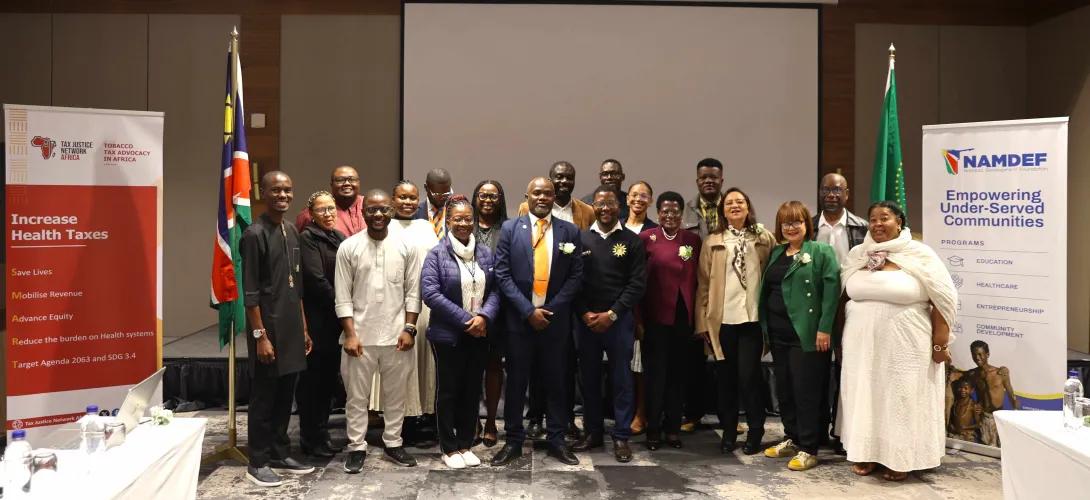
Tax Justice Network Africa (TJNA), in partnership with the Namibia Development Foundation (NAMDEF), launched the Tobacco Tax Advocacy in Africa (TTAA) Project during a high-level stakeholder meeting held in Windhoek, Namibia on 21 May 2026.
Held under the theme “Strengthening Tobacco Taxation and Tobacco Control for Improved Public Health and Domestic Resource Mobilisation in Namibia,” the launch convened representatives from the Ministry of Health and Social Services, the Ministry of Finance and Public Enterprises, the Namibia Revenue Agency (NamRA), development partners, civil society organisations, academia, and regional institutions.
The meeting created a platform for dialogue on tobacco taxation, illicit tobacco trade, tobacco control, sustainable financing, and the role of evidence-based policymaking in strengthening public health outcomes in Namibia.
The launch comes at a critical time as Namibia, like many African countries, continues to face mounting pressure on healthcare systems, growing public health challenges linked to tobacco use, and rising demands for sustainable domestic financing.
Namibia has made progress in tobacco control; however, stakeholders acknowledged that challenges remain in strengthening enforcement, reducing the illicit tobacco trade, improving coordination, and raising awareness of the harmful effects of tobacco consumption, particularly among young people.
In his opening remarks, TJNA’s Policy Officer, Mr. John Thomi, described the launch as both the culmination of a long and deliberate process and the beginning of a renewed journey to safeguard public health, protect the revenue base, and strengthen the human capital of the people of Namibia.
“Tobacco control requires strong advocacy, public awareness, and accountability from all sectors of society. Stronger tobacco taxation offers a “double dividend” by increasing domestic revenue while simultaneously reducing tobacco consumption and the burden of non-communicable diseases. Evidence continues to guide our resolve,” Mr. Thomi highlighted.
Participants highlighted that increasing tobacco taxation remains one of the most effective measures for reducing tobacco consumption and generating sustainable domestic revenues to support healthcare systems and national development priorities.
Speaking during the launch, Ms. Celia Kaunatjike from the World Health Organisation (WHO) Country Office in Windhoek, highlighted WHO’s ongoing collaboration with the Ministry of Health on tobacco control, including legal and policy reforms, tax policy support, awareness campaigns, and enforcement capacity development.
“We welcome NAMDEF’s involvement in supporting tobacco control efforts in Namibia. Through stronger collaboration, we can address existing gaps in tobacco control, strengthen enforcement and response systems, and ensure that Namibia’s tobacco control framework aligns with global standards, including the WHO Framework Convention on Tobacco Control (FCTC),” Ms. Celia Kaunatjike noted.
Ms. Helen Mouton from the Ministry of Health emphasised that tobacco control is not simply a policy discussion, but a public health priority.
“Namibia has already made significant progress in tobacco control, including restrictions on tobacco advertising and ongoing efforts to strengthen smoke-free public spaces. However, the tobacco industry continues to target vulnerable groups, especially young people,” she noted.
She further reaffirmed the Ministry of Health’s commitment to strengthening tobacco control measures, including plans to amend the Tobacco Products Control Act and support higher tobacco taxes as a tool to reduce accessibility and consumption.
“Excise taxes on tobacco products remain an important revenue stream; it requires stronger enforcement systems. Namibia continues to face challenges related to cigarette smuggling, informal cross-border trade, misclassification of tobacco products, and weak monitoring systems at border points,” Mr. Kephas Shatona, from the Namibia Revenue Agency (NAMRA) stressed during his presentation.
The discussions also highlighted the need to strengthen collaboration among fiscal authorities, public health institutions, civil society organisations, and development partners to ensure the coordinated implementation of tobacco control measures.
Ms. Anita Beukes of the Ministry of Finance highlighted the growing importance of sustainable financing mechanisms as countries face rising public healthcare expenditure.
“Regional and global experiences continue to show that effective tobacco control policies contribute to healthier populations, increased productivity, and more resilient economies,” she said.
Stakeholders agreed that stronger evidence, public engagement, and cross-sector collaboration will be essential in building support for tobacco taxation reforms and advancing Namibia’s broader public health goals.
“As we conclude, let this not only be a launch, but the beginning of strong partnerships, informed advocacy, and sustained action,” NAMDEF’s Executive Director, Ms Alexinah Muadinohamba, implored during her closing remarks.
As the meeting drew to a close, TJNA and its stakeholders reaffirmed a collective commitment to bold, coordinated action—transforming shared resolve into lasting change and securing a healthier future for all Namibians.
For more information about the Tobacco Tax Advocacy in Africa project please contact John Thomi at jthomi[@] taxjusticeafrica.net
