
From 30 November to 10 December 2026, governments will meet in Nairobi for the sixth session of the Intergovernmental Negotiating Committee (INC) of the UN Framework Convention on International Tax Cooperation. This will be the final scheduled session of INC in Nairobi, as the following sessions will take place in New York in 2027. In Nairobi, negotiators will discuss the draft framework convention which includes provisions on the fair allocation of taxing rights, governance structures through the conference of parties, and the relationship between the convention and existing bilateral treaties. Member States will also negotiate the protocol on how to prevent and resolve cross-border tax disputes.
To contextualise, multinational companies (MNCs) can earn income and make profits from markets where they have no physical presence, while tax authorities can struggle to get the information they need to see where profits are made and where taxes are paid. Compounding this issue further, is the entrenchment of tax rules in double tax agreements, that are no longer fit for purpose as MNCs can now generate revenues with no physical presence in the jurisdictions in which they earn income.
For African countries, the fair allocation of taxing rights is a practical and pressing issue, given the significant profits MNCs generate from economic activities on the continent and without paying their fair share of taxes in the countries they operate in. In mid-2025, it was estimated that some companies headquartered in the global north earned about US$26 million a month from subscriptions in sub-Saharan Africa without any physical presence. In June 2026, another company also headquartered in the global north had an estimated 300 000 customers across 26 African markets, with Nigeria, Zimbabwe and Zambia accounting for about 64%.
For African countries, fairer taxing rights could mean more resources for public services and long-term development. That is why at the 14th Pan-African Conference on Illicit Financial Flows (IFFs) and Taxation (PAC) 2026 held in Dakar, Senegal, TJNA and its partners called for African countries to support and shape the UN Tax Convention so that it delivers a fairer share of taxing rights.
At the same time, addressing illicit financial flows requires more inclusive international cooperation, particularly through effective exchange of information mechanisms that enable African countries to curb substantial revenue losses. Within this context, the Framework Convention presents a unique opportunity for African countries to align their international tax engagements with their national ambitions to increase domestic revenue to finance sustainable development. The Framework Convention offers a pathway to strengthen progressive taxation, reduce reliance on regressive taxes, and ensure that those with the greatest ability to pay make a fair contribution to domestic revenue.
African countries have played a pivotal role in driving this process through the Africa Group (AG). The Africa Group, under the leadership of Nigeria brought global tax negotiations to the United Nations so they could have a greater say in shaping the rules that affect how much tax they can collect. In April 2026, in her UN Tax Convention blog, TJNA's Executive Director Ms. Chenai Mukumba traced how the African leadership began a formal UN tax convention negotiating process and she highlighted the priorities for African countries in the negotiations.
As negotiations continue, the Africa groups' leadership continues to be instrumental in the process.
From New York to Nairobi
At the fifth session of the INC, held in New York in August 2026, Member States negotiated on the text of the Framework Convention and the two early protocols focused on how to share taxing rights, how tax authorities should exchange information and what the Framework Convention means for existing tax bilateral treaties.
TJNA and the African CSOs Working Group on the UN Tax Convention still maintain that Article 5 on fair allocation of taxing rights in the Framework Convention, remains the heart of the convention and ultimately, the bedrock for reform of the international tax architecture. The call remains that the Framework Convention cannot contain high-level commitments that fail to provide Global South countries with fair allocation of taxing rights.
Likewise, at the fifth session of INC, the Africa Group pushed for clear commitments that would allow countries to tax a fairer share of the income MNCs earn in the markets where they operate, especially on the continent. This contrasts with the positions of several other delegations, which wanted the Framework Convention to set broad principles and leave detailed text to protocols. The challenge is that each country can decide whether to join a protocol or not. Whilst the objective of fair allocation of taxing rights is not missed by Member States, many developed countries still argued that Article 5 should remain at a high level, avoid creating substantive allocation rules, minimise legal uncertainty, and preserve the balance between source and residence taxation.
In addition to the substantive provisions, the issues on governance structures of the framework convention remain important going into the sixth session in Nairobi. In the August discussions on the Framework Convention, the Africa Group called for a strong Conference of Parties (COP) that would be the supreme decision-making body under the Framework Convention with a wide mandate to ensure the implementation and enforcement of commitments under the Convention. Other delegations felt that the COP should play a more facilitative role rather than an obligation- setting role as proposed by the Africa Group.
On the programme of the sixth session, the negotiations shall negotiate the text on tax disputes which is covered under Protocol 2. The Africa Group backed keeping direct talks between tax authorities at the centre of the process and opposed compulsory arbitration, saying it could take decisions out of the hands of national authorities. The detailed rules for taxing income from cross- border services under Protocol 1 shall be negotiated at the seventh session of INC taking place in New York in January 2027.
What TJNA and the Africa Group is calling for
In Nairobi, TJNA’s focus is on the Framework Convention, which would set the substantive and procedural rules and commitments for taxing cross-border income and cooperation on tax matters. Because countries that sign onto the Framework Convention can decide separately whether to sign the protocols, TJNA wants the key commitments on international tax in the Framework Convention itself.
“Everything rests on Article 5,” says Dr Zandile Ndebele, TJNA Policy Assistant. In Nairobi, the first week of the negotiations shall see governments discuss the revised draft of the framework convention that was published by INC on 16 November 2026. TJNA supports that Article 5 should expand the rules on allocation of taxing rights to reflect where economic activity takes place, where MNCs have markets, customers and earn revenue, even without physical presence.
Another key focus going into the sixth session of INC is on Article 21 which proposes that countries take steps to bring existing bilateral agreements, including double tax agreements into line with the framework convention, including renegotiating them where necessary. In previous INC sessions, the submissions that the framework convention should be a fast-track instrument overriding any double tax agreements that are not consistent with it. However, the issues of tax sovereignty were raised as a challenge to this position. Thus, a key question in Nairobi is how firmly the Africa Group will hold the line and maintain the commitment to a text that protects its taxing rights.
Taxing rights have been limited by existing treaties. The Africa Group wants those treaties brought into line with the Framework Convention, and Article 21 of the revised draft proposes renegotiation where necessary. TJNA similarly wants the Framework Convention to require countries to review bilateral tax treaties that limit their taxing rights and end them where necessary. As Ms. Ruth Wamuyu, TJNAs, Policy, Research and Advocacy Manager explains, Kenya has already faced court challenges when trying to tax fees paid to overseas service providers under such treaties.
TJNA is also following Article 6 on taxing high-net-worth individuals. The Africa Group wants countries to cooperate more closely on taxing wealthy individuals who earn income or hold assets abroad. As Mwaniki Maina puts it on his blog which is part of TJNA's UN Tax Convention blog series, wealth taxation calls for “a coordinated international approach”.
Other priorities for TJNA include Article 7 on tax-related illicit financial flows, avoidance and evasion, and Article 8 on harmful tax practices. Articles 10, 11 and 12 cover how tax authorities help one another, exchange information, and receive training and technical support, respectively. To help tax authorities tackle abuse, TJNA's Senior Policy Officer Ms. Everlyn Muendo calls for multinationals to publish their revenue, profits and taxes paid in each country. This would help authorities and the public see where companies do business and where they pay taxes.
Finally, TJNA wants every country to have an equal say in setting up global tax rules. It also calls for a strong governance structure through the Conference of the Parties, established under Article 13, to have the power to oversee and enforce commitments. The aim is to help countries raise the resources they need for public services, sustainable development, and gender-responsive programmes.
Where TJNA will be engaging
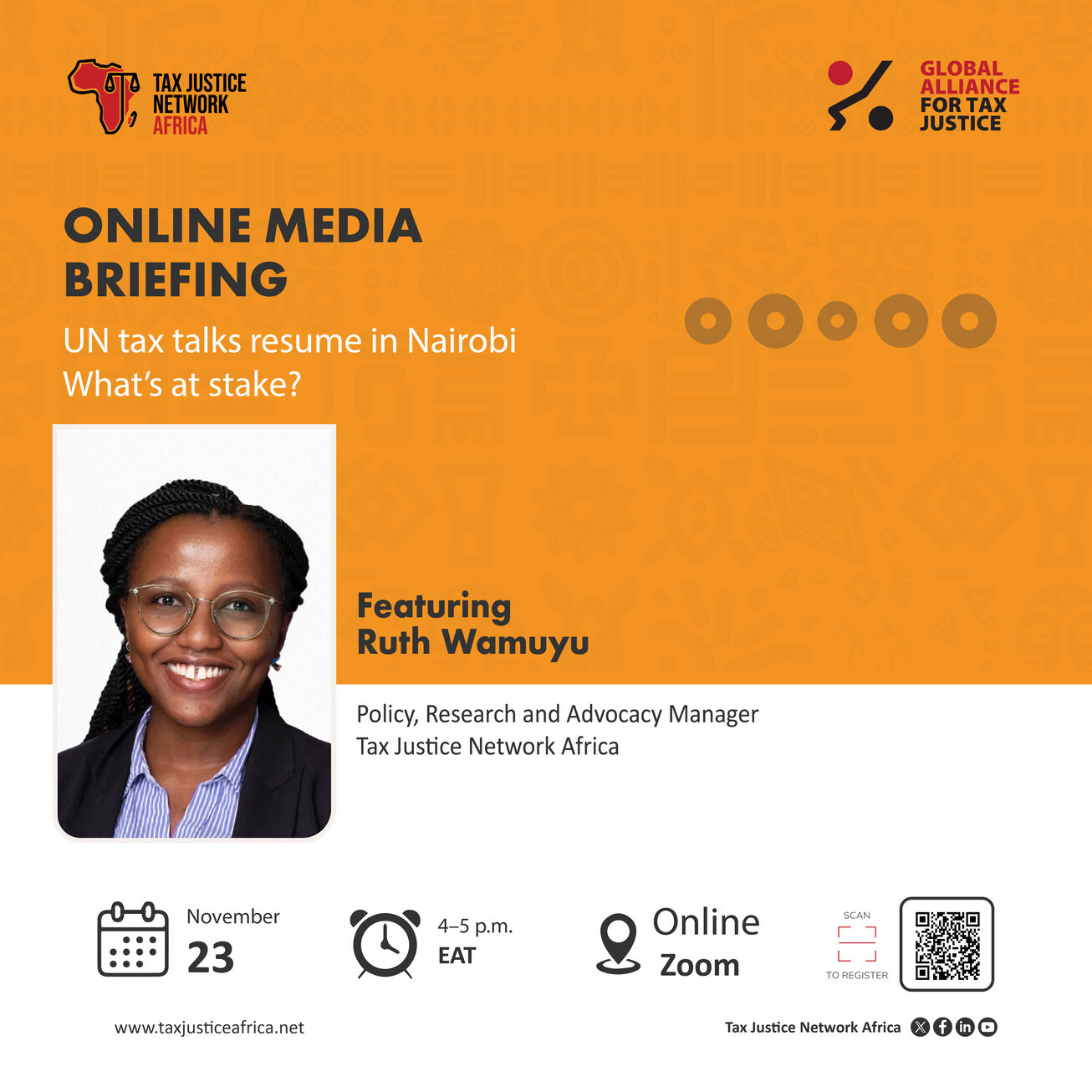
TJNA lined up several strategic engagements before, during and after the Nairobi negotiations. The first was an online media briefing on 23 November, organised in partnership with the Global Alliance for Tax Justice and other partners. TJNA then took part in Greenpeace Africa’s training on 24 November and media briefing on 25 November.
On 27 November, TJNA will take part in a training session organised by the All Africa Conference of Churches. On 28 November, it will convene African civil society organisations to discuss priorities for the negotiations and join a separate briefing with the Tax Justice Network and partners that afternoon. On 29 November, TJNA will facilitate a session at the tax and gender working group to help participants agree on shared priorities ahead of the talks.
During the negotiations, TJNA will make submissions alongside members of the Africa CSOs Working Group on the UN Tax Convention, take part in a Friedrich-Ebert-Stiftung (FES) side event on 2 December and coordinate with civil society partners throughout the session.
After Nairobi, TJNA will carry this advocacy into the January 2027 talks in New York, where it will continue pushing for rules that give African countries a fairer r share of taxing rights and effective mechanisms to tackle illicit financial flows.
What the Nairobi talks mean for Africa’s development
What governments agree in Nairobi could affect how much African countries can raise to fund public services. Can children get quality education? Will public hospitals have the medicines patients need? Can farmers and small businesses rely on good roads to get their goods to market? A fairer share of tax revenue from multinational companies and high-net-worth individuals can help fund those services and ensure there is adequate investments into reliable electricity and technical training. These investments can help African economies produce more of what they use, create jobs and retain more of the value they generate.
The negotiations come as funding for essential services is shrinking. An analysis by the International Monetary Fund, based on United Nations humanitarian funding data, estimates that humanitarian aid to sub-Saharan Africa fell by 42% in 2025 compared with 2024. In the Democratic Republic of the Congo alone, spending administered by the US Agency for International Development (USAID) fell by US$503 million, from nearly US$1.2 billion in the 2024 US fiscal year to US$693 million in 2025, according to the Center for Global Development.
At the 14th Pan-African Conference on Illicit Financial Flows and Taxation (PAC) 2026 in Dakar, TJNA’s Executive Director, Ms. Chenai Mukumba, asked, “How should development be financed?” That question goes to the heart of fiscal sovereignty, a priority in TJNA’s 2026 - 2030 Strategic Plan, themed Beyond Revenue. Fairer taxing rights can give African countries more power to raise their own revenue and decide how to spend it, so that funding schools, hospitals and long-term development depends less on decisions made by external donors. That ambition helps explain why African governments pushed to bring global tax negotiations to the United Nations in the first place.
For more information about the negotiations and TJNA’s programs, please contact Ms. Ruth Wamuyu, the Policy, Research and Advocacy Manager at rwamuyu@taxjusticeafrica.net and Ms. Everlyn Muendo, Senior Policy Officer, Tax and International Financial Architecture, emuendo@taxjusticeafrica.net
