
Please scroll down for subsequent updates.
Day 1: 4 August 2025
4 August 2025 marked the beginning of the First Session of the historic Intergovernmental Negotiating Committee (INC) on the United Nations Framework Convention on International Tax Cooperation. The session’s agenda included the by-election of officers, the confirmation of accreditation of stakeholders such as international organisations and civil society, and general remarks provided by Member States and other stakeholders.
Taxation of the Digitalised Economy
The session was officially opened by the new INC Chair, Egypt’s Deputy Minister of Finance for Tax Policy and Reforms, Ramy Youssef. The Chair commended the work of the 3 workstreams namely:
- Workstream 1 on the UN Framework Convention on International Tax Cooperation
- Workstream 2 on the Protocol on taxation of income derived from the provision of cross-border services in an increasingly digitalised and globalised economy (Protocol 1)
- Workstream 3 on the Protocol on prevention and resolution of tax disputes (Protocol 2)
The Chair noted that more than 100 Member States were actively participating in the negotiations within the workstreams and commended the issues notes provided by each workstream. The issues notes guided the discussions of the INC during its First and Second Session. The main issues discussed were as follows:
- Framework Convention on International Tax Cooperation: The commitments on fair allocation of taxing rights and equitable taxation of multinational enterprises, effective prevention and resolution of tax disputes, and sustainable development;
- Protocol 1: Clarifying the scope of Protocol 1 in relation to the cross-border services that shall be covered; discussing the challenges with the current rules on the taxation of cross-border services, and discussing possible new approaches to the taxation of cross-border services;
- Protocol 2: Discussing barriers to effective dispute prevention and resolution and providing the scope and approach of the protocol.
The Chair opened the floor for general remarks. Various African countries, including Algeria, Cameroon, Ghana, Kenya, Morocco, Nigeria, and Tanzania, took the floor to make statements. Statements by continental and regional organisations, including the African Union and the African Tax Administration Forum, aligned with the African Group.
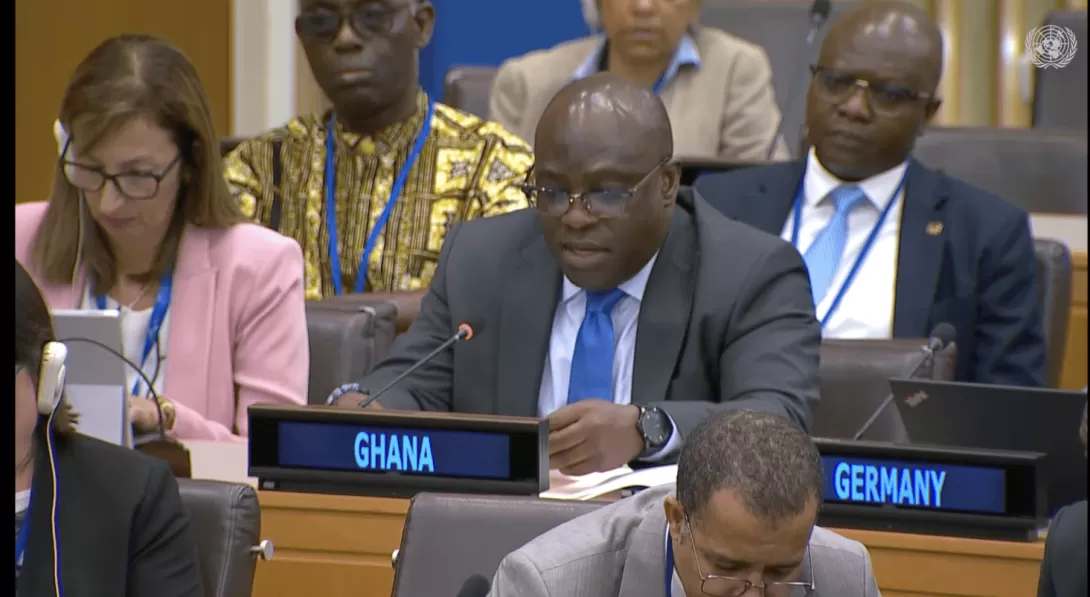
Ghana, speaking on behalf of the African Group, reiterated that Member States should promote a truly universal process that addresses historical imbalances where nations were denied a seat during negotiations on the current global tax structure. Ghana drew attention to the recent G7-USA deal, which granted the USA an exemption from international tax rules. This international deal that provides an exemption for the USA illustrates how current international tax rules are fragmented and defunct.
On workstream 1, Ghana, Kenya, and Tanzania, amongst others, called for the broadening of commitments to include effective taxation of natural resources. On workstream 2, Ghana, seconded by Algeria amongst other African countries, called for adherence to taxation based on where economic activity takes place and where value is created. Algeria emphasised the importance of the allocation of taxing rights for market jurisdictions. On workstream 3, Ghana called for fair, accessible, and balanced dispute resolution mechanisms. Additionally, Nigeria called for the exploration of public country-by-country reporting and effective exchange of information as a means of preventing disputes. The African Group also supported the elaboration of structural elements of the Framework Convention, emphasizing the need to begin discussions on the governance structures of the Convention, including a possible Conference of Parties as well as subsidiary bodies. Cameroon, in its inaugural statement within this process, emphasised that the development of the texts of these instruments across the workstream was a matter of economic urgency that had a heavy bearing on the delivery of human rights in African States.
Day 2: 5 August 2025
Consideration of Commitments on Dispute Prevention and Resolution, Fair Allocation of Taxing Rights and Sustainable Development within the United Nations Framework Convention on International Tax Cooperation
5 August 2025 was the second day of the Intergovernmental Negotiating Committee (INC) on the United Nations Framework Convention on International Tax Cooperation. The session’s agenda included the discussion of effective prevention and resolution of tax disputes. Also, the Committee was invited to discuss the issue of the fair allocation of taxing rights and to discuss the issue of international tax cooperation approaches that contribute to sustainable development, and in particular, other additional aspects to add to the article on sustainable development.
The Chair, Egypt’s Deputy Minister of Finance for Tax Policy and Reforms, Mr Ramy Youssef opened the floor to general remarks after the co-lead, Mr Daniel Nuer, Ministry of Finance, Ghana; Member of the Africa Group on the Bureau of the Intergovernmental Negotiating Committee, had presented on the key issues which the session would focus on.
- Dispute Prevention and Resolution
In particular, the Committee was invited to discuss a) whether the elements of the commitments, fair, independent, accessible, and effective dispute prevention and resolution mechanisms, would address the concerns that were expressed in the workstream b) concerns with the workstream on dispute prevention and resolution.
Nigeria, on behalf of the African Group, affirmed its commitment to a fair and inclusive international tax system. It welcomed the prioritisation of commitments but specified that all items, especially procedural aspects, deserved careful consideration. It commented on Paragraph 9 of the Issues Note as to whether the language sufficiently addresses concerns on effective dispute prevention and resolution. Nigeria’s position was that the said paragraph did not sufficiently address the issue. It stated that the commitment should not be based on the motivation of the commitment; the wording will be constraining and would not allow for the adaptability of the commitment. Thus, whether Paragraph 9 provides sufficient support for Protocol 2, underscores the issue of preference and capabilities, noting that members have spoken about tax sovereignty was put to the floor.
Other additional concerns – under this commitment, particular issues should be addressed under the relevant convention. The procedural aspects should be left to the protocol. The protocol will address operational concerns. Also, dispute resolution should provide legal certainty and equitable access.
Cameroon aligned with Nigeria. It stated that the Committee must be unequivocal that commitments that do not transform into balanced mechanism are risky and that elements should go beyond aspirational language, and must be very clear. While it recognised the importance of legal certainty, it reiterated that the principle is not sufficient to safeguard all member States. It further stated that there was a need for clear, simple, and easily comprehensible rules, particularly rules in complex areas such as transfer pricing. They stated that crucial measures should be in place for preventing disputes before they even arise. Rules should promote a more equitable environment whilst promoting domestic resource mobilization.
The African Union stated that accessibility and accountability for all countries, especially those without treaty was important. A commitment that recognizes the different abilities of States was necessary. AU called for tax sovereignty and the principle of multilateralism.
The Africa Tax Administration Forum (ATAF) supported statements by Nigeria, the African group, and the AU. It stated that there should be detailed as high-level commitments in the convention. Paragraph 9 has issues which should not be overlooked, such as Advance Pricing Arrangements (APAs), which have been a challenge for African countries.
- Sustainable Development
The co-chair of workstream 1, Mr Nuer, stated that the commitment in the current form serves as an anchor for future protocols. In particular, the commitment aims to ensure that international tax cooperation is aligned with the achievement of sustainable development in its three dimensions: economic, social, and environmental. The Committee was invited to discuss the issue of international tax cooperation approaches that contribute to sustainable development and, in particular, whether there are additional approaches that contribute to sustainable development that should be addressed in additional paragraphs of the article of the Framework Convention.
On Sustainable development, the African Union stated that it welcomed what is in the issue note and encouraged alignment with Agenda 2030. It urged the Committee to reference equitable taxation with the achievement of the Sustainable Development Goals (SDGs). It underscored the urgency of implementing resolution 79/235 and establishing the Secretariat for the realization of the Commitments.
Nigeria, on behalf of the Africa Group, stated that the Framework Convention is meant for purposive goals, thus it was important not to overlook the different capacities of different countries. It further emphasized that discussions around the Framework Convention aimed to achieve a specific goal, which is the implementation of the UN's Sustainable Development Goals (SDGs) in all countries, and that DRM was crucial for achieving SDGs. It is considered the proposed language appropriate as it captured the intention of enabling states to generate revenue for sustainable development. It stated that the African Group was open to discussing any aspects that might have been left out, but it believed that the current language effectively captured the essence of sustainable development.
Cameroon stated that the Committee should move from broad-based commitments to targeted commitments, that it must do more than align with abstract SDGs, must incorporate environmental and social commitments, and include binding commitments.
Zambia concurred that the language of the commitment was broad enough and aligned with the capacities of each State. Tanzania and the AU also aligned with Nigeria.
- Other Elements within the Framework Convention: Objectives and Principles of the Framework Convention
Austria and Canada directed the discussion to the need for objectives and principles in the convention as it considered them important and encouraged that the discussion on the commitments should also include objectives and principles. The Chair indicated that the commitments were the core business of the negotiations and in any event, the objectives and principles are contained in the Terms of Reference (ToR). Algeria stated that the TORs are already adequate on the issue of objectives and principles. Nigeria stated that there was no need for Member States to reinvent the wheel of the objectives and principles. The African Union (AU) stated that it aligned with the position of Nigeria, India, and Kenya. It stated that the ToR were broad enough to lay the ground in terms of the drafting of the convention and that all additional suggestions of the ToR should be consistent with what was passed in the General Assembly. It highlighted that the African Group was present to change the narrative of international tax cooperation to ensure domestic resource mobilization (DRM) was achieved to finance State development. Prior to the statement by the AU, Kenya stated that alignment with previous international tax laws meant maintaining the status quo, and that would not help international tax cooperation. In very clear terms, Kenya reiterated that it was present to challenge the existing status quo to avoid a replication of the current international tax rules. Tanzania supported statements delivered by Nigeria, the AU, and the African Group. They called for the focus to be on creating a new international tax mechanism and not replicating the one present.
- Fair Allocation of Taxing Rights Including Equitable Taxation of Multinational Enterprises
On the fair allocation of taxing rights, the co-chair of Workstream 1, Mr. Daniel Nuer, urged parties to promote approaches where all jurisdictions where business activity takes place share taxing rights over related income, and that it should be balanced with principles of economic efficiency, tax neutrality, simplicity, and effects on cross-border trade and investment. The committee was then invited to discuss whether the elements presented by the the co-chair of Workstream 1 provided a useful outline of a commitment on this topic and if there were additional concerns needing addressed in the articles of the Framework Convention.
Nigeria, speaking on behalf of the Africa Group, said there is rapid change in the global economy and that the way of doing business is more dependent on digitalisation, dematerialisation, and mobility of profits. It further said that the Framework Convention should be designed to be future proof, flexible, and respect the sovereign taxing rights of states. The Framework Convention should also address existing imbalances in the taxing rights as regard residence and source jurisdiction. Whilst it commended the co-chair, Nigeria made specific reference to the fact that the Convention should avoid including detailed explanations, criteria or defining fair allocation as doing so would remove attention from the real issues. Nigeria further noted that the language should be simple as in the ToRs. It highlighted that the elements should be indicative rather than exhaustive. To conclude, Nigeria indicated that it believed that there should be value creation especially for source countries.
The ATAF aligned with Nigeria and the African group on fair allocation. They stated that the ToRs need to be revisited and follow Paragraph 10 as a guide to frame the commitment. They indicated primarily that different countries need different solutions - new taxes for some while ensuring taxes are not excessive for others. They stated that this approach can apply broadly, including to treaty rules and multinational corporations. They supported language that aligns with the ToRs without needing to be overly definitive.
Day 3: 6 August 2025
The discussion on the commitment on ‘fair allocation of taxing rights’ continued on day 3.
The African Group was in support of a broad commitment in this area that was aligned with paragraph 10 of the Terms of Reference. Additionally, Nigeria, on behalf of the African Group, aligning with India, indicated that they were in support of the removal of elements such as economic efficiency, tax neutrality, amongst others, as these were sufficiently covered within the principles.
Kenya, in support of Nigeria, took issue with the words ‘business activity’ within paragraph 14 of the issues note of workstream 1, citing that it would be difficult to interpret and might be restrictive, and would rather replace this with ‘[…] where economic activity takes place.’
In the afternoon, to put into context what was meant by broad or high-level commitments, the Co-Chair of Workstream 1 provided an example of possible wording on the commitment on ‘fair allocation of taxing rights’ as follows:
The State Parties agree to work together to ensure that all taxpayers, especially multinational companies and transnational corporations, pay taxes to the Governments of countries where economic activity occurs, value is created, and from where revenues are generated.
India supported the 3 concepts, including value creation, taxation where economic activity takes place, and revenue generation, citing that they were measures that could be used to measure how fair, a share of taxing rights is. Kenya, expressed a preference to use the approach of the Terms of Reference; however, if the commitment was to be further elaborated, Kenya was in support of the three factors however Kenya pointed out the need to include ‘fair allocation of taxing rights ‘within the commitment. Additionally, in support of the concerns highlighted by civil society on the word ‘especially’ and how this could limit taxation to only corporates, Kenya insisted on replacing the word with ‘including’. Ghana and Cameroon were in support of these positions. Nigeria cautioned that the INC was not at the drafting stage, but appreciated that the statement captured the essence of what the commitment should cover. Additionally, Nigeria cautioned against the use of language in the Compromiso de Sevilla (Financing for Development 2025 outcome document) highlighting that the mandate of the INC (intergovernmental negotiating committee) came from the UN General Resolutions 78/230 and 79/235 and therefore, the INC should not feel pressured to use the language of the provisions therein.
Mutual Administrative Assistance and Exchange of Information
The co-chair of the workstream directed Member States to provide feedback on challenges that they faced in providing and receiving information through the exchange of information.
Nigeria highlighted that from the African Group's perspective, this was a cross-cutting issue as the exchange of information had implications for the fair allocation of taxing rights. Where information is not available, taxation is almost impossible to do. Nigeria expounded on 3 main issues that particularly affect developing countries, amongst African countries. These include:
- The limited treaty network of many of these countries
- The high costs required of these countries in order to meet the standards under the Global Forum, since setting up the structural components can be quite costly for least developed tax administrations.
- The peer review mechanisms do not look at the capacity and capability of many tax administrations. Therefore, many countries with smaller and less capacitated tax administrations are unable to meet the standards and access information.
Lesotho, speaking as a smaller jurisdiction, aligned with the observations made by Nigeria. Zambia aligned with the position of Nigeria. Kenya, in support of Nigeria, cautioned, that this was not just a matter of lack of capacity. Despite Kenya investing in the legal frameworks and the structural components, Kenya highlighted that it still faced issues with receiving information. Therefore, despite meeting the standards, they were still unable to receive information. Kenya highlighted its preference to have mutual administrative assistance as a commitment, aligning with the Terms of Reference.
Day 4: 7 August 2025
There were no plenary sessions on the 7th of August 2025.
Day 5: 8 August 2025
Taxation of High Net Worth Individuals
Member States discussed other proposed commitments for the UN Framework Convention on International Tax Cooperation. Member States were directed to discuss what the barriers were towards effective taxation of high net worth individuals.
Nigeria highlighted the difficulties of taxing politically exposed persons, as in many developing countries, the wealthy also have political power. Cameroon pointed out the importance of the exchange of information for the taxation of HNWI. Highlighting that the relevant information in order to effectively tax HNWI is often held abroad. Hence, ineffective exchange of information frameworks are a significant barrier. Côte d’Ivoire, highlighted the use of tax havens, hybrid mechanisms, and other sophisticated arrangements as major barriers towards taxing HNWI. They highlighted that tax competition often promotes capital flight, leading to a situation whereby national measures are rendered ineffective. The ideological opposition between wealth tax and freedom of enterprise often slows progress as well. Lastly, political challenges hinder the taxation of HNWI. Kenya highlighted the importance of beneficial ownership; however, they said that in practice, it has been very difficult to track the ultimate beneficial owner due to the use of complex structures, particularly in the case of trusts. Zambia highlighted the lack of information as one of the major barriers, emphasizing that this was also a problem of limitations with sharing information at the inter-agency level, leading to siloed information.
Effective mutual administrative assistance
Member States were directed to provide input on what their country’s experience was with assistance in tax collection and what they believed the Framework Convention should address in this respect.
Zambia, Ghana, and Lesotho highlighted that one of the major issues was the lack of a clause of mutual administrative assistance within many tax treaties, and even when this clause existed, there were reservations, thus affecting its effectiveness. Furthermore, Nigeria pointed out the lack of a domestic enabling legal framework that allows the tax authority to work towards assistance in tax collection. Kenya and Ghana supported the elimination of reservations in multilateral frameworks so that mutual administrative assistance can take place more effectively.
Member States moved to the formal session, and the Chair officially closed the First Substantive Session of the INC on the UN Framework Convention on International Tax Cooperation.
Day 6: 11 August 2025
The Second Substantive Session of the Intergovernmental Negotiating Committee (INC) on the United Nations Framework Convention on International Tax Cooperation began on 11 August 2025. Two meetings were held to discuss Protocol 1 on Taxation of income derived from the provision of cross-border services in an increasingly digitalized and globalized economy.
In the first meeting of the session, statements were made by Member States. Ghana, on behalf of the African Group, emphasized the need to avoid the reinforcement of existing imbalances, the need to level the playing field, and promote equity and tax sovereignty. Also, any solution to the taxation of digital services should be future-proof, include a broad range of services and revenues collected where economic activity takes place. On protocol 2, the African Group called for a fair, accessible, and balanced dispute resolution framework, with strong safeguards and regionally adaptable compliance models. They stated that all members should engage with the protocol with a shared commitment to justice and want a framework that serves all nations.
Nigeria, aligned with Ghana and the African Group. For Nigeria, on Protocol 1, there was a change in the way of doing business globally, and this necessitates a change in international tax rules to reflect that. With protocol 2, there was a need to define the terms to avoid misinterpretation of the application of the rules. They favoured optionality of dispute resolution mechanisms and were opposed to mandatory arbitration.
Mauritius, made presentations for the first time since the sessions began and stated that it was in support of Protocol 2 without going into the specific aspects of the protocol. It further stated that it shared the view that there should be a level playing field, fairness, and equity. The Protocol had to ensure that there was respect for state sovereignty. It concluded that it was anticipating working with the African Group and other members present.
Tanzania, aligned with Ghana for the need of a future-proof Protocol 1. They preferred simple and effective rules, such as gross basis withholding tax, and urged the members to look at Article 12 AA, 12 B, and 12,C, which deals with the balancing of taxing rights between source and resident states. In addition, the Protocol should included anti-avoidance rules. On Protocol 2, it stated that the focus should be on cross-border disputes and is opposed to arbitration as these disadvantage developing countries.
Côte d'Ivoire, like other African Member countries, recognised that Protocol 1 was necessary as the current global tax rules are failing and stated the need to tax MNEs in countries where there is no physical presence. They were in support of withholding taxes on a gross basis, for example, on the local turnover figure, taxation of all cross-border services, including automatised services, and the need for EOI and data from digital platforms. Further, on Protocol 2, they indicated that this ought to be a multilateral protocol covering cross-border disputes, addressing transfer pricing, prioritising amicable solutions such as optional arbitration but compulsory procedural basis.
Zambia closed the formal sessions by supporting Ghana, Nigeria, Tanzania, Mauritius, and Côte d'Ivoire. It reiterated that there was a need to acknowledge the existing global tax framework, especially when looking at Protocol 1, but should use it as a foundation to determine what has worked well and what has not. They agreed that the capacities of developing countries should be taken into account not only in cross-border services but also in digital services.
Informal Meeting
Discussion on Workstream 2/Protocol 1 Taxation of income derived from the provision of cross-border services in an increasingly digitalized and globalized economy
This session began with a presentation on Protocol 1 by the co-lead of workstream 2, Ms. Liselott Kana, who in particular, gave four examples of different types of digital services. Three questions from the issues note on taxation of digital services were discussed in addition to the four examples given during the presentation.
Kenya submitted that the scope of the protocol should cover a wide range of services and not be limited to traditional services as a way to ensure that rules are future-proof. Further, Kenya was in support of aligning tax rules with where revenues are generated, or where value is created. On the issue of working within the existing tax rules, Kenya stated that the current rules do not align with new ways of doing business and this moves the discussion away from the call for compatibility or conformity with the existing rules, policies and practices. They further submitted that any global tax rules should consider contributions by source states and ensure fair allocation of taxing rights by recognising market contributions. They advocated further for simplicity and ease of administration such as apportionment of income or gross basis withholding taxes. Last, they advocated for a fast-track multilateral instrument addressing any limitations that bilateral tax treaties have imposed on the taxing rights of source taxation countries.
Algeria also aligned with the African Group and stated that for Protocol 1, the criteria of physical presence has shown limitations. They indicated that the new digital model of doing business creates a competitive distortion with local service providers leading to unfair competition, and that the protocol should have clear, simple, and easily administrable rules for B2B and B2C . Like Kenya, Algeria advocated for taxing rights for market jurisdictions. For Algeria, the protocol should only be limited to income taxes.
After these submissions, the co-lead highlighted that the discussion was intended to bring up to date those members who did not participate in the workstream discussions and also to get submissions on potential omissions in the issues notes on protocol 1.
The African Tax Administration Forum (ATAF) submitted that Protocol 1 should consider intra-group services and the significant role it plays in IFFs. They stated that the extant rules do not lead to proper taxation of digital services. They highlighted that taxation of income should be the focus, digital services taxes should not mirror indirect taxes, and that effective taxation under Protocol 1 requires a solid grasp of the transfer pricing system's basics.
After the adjournment, Nigeria submitted that it advocated for the adoption of rules such as significant economic presence (SEP), which were simple and flexible and also supported gross-based withholding tax, provided the rate was favourable. They proposed an alternative to the current transfer pricing rules, which they considered complex, shifting of the tax burden to service providers, curbing tax avoidance, and double taxation. For Ghana, the need to flexible, future-proof proof and adaptable rules was necessary. Like Kenya, they advocated for a fast-track mechanism that addressed the barriers in the pre-existing tax treaties. They stated that the focus should not end with DRM but with the provision of basic needs to citizens, such as education and healthcare.
Senegal made its submissions and aligned with the Africa Group. They advocated for the need to understand the technical issues at hand, such as the different categories of services and the need to define what does not fall within the definition of digital services. Defining the elements, assists to understand what multilateral mechanisms or instruments need to be put in place. Further, it indicated that the scope and vision of the protocol need to be defined in order to better define technical elements.
Algeria commented on the transfer pricing comments made by other delegates. It is submitted that applying transfer pricing rules to cross-border services poses significant challenges for developing countries due to limited capacity and lack of access to reliable data. Further they submitted that the required sophisticated audits, benchmarking, and dispute resolution mechanisms are not easily administrable for developing countries. Thus, a simpler and easy to administer alternative is needed and this would enable the mobilisation of revenue from cross-border services without excessive administrative burdens.
Lesotho in response to the debate on net taxation as opposed to gross-based withholding taxes, responded to previous statements made about gross-based withholding taxes discouraging cross-border investment and trade. Lesotho stated that the market should determine tax incidence, and that member States could not influence this. According to this view, we should let market forces handle tax incidence and focus on finding the lowest tax rate as a basis for net tax, rather than worrying about its impact.
Kenya made further submissions that they support gross-based taxation. On the issue of economic analysis, suggested by other delegates, Kenya referred to guidelines for inter-sessional work, under paragraph 15 that provides that the role of the secretariat is to provide support by providing data and drafting an analytical report; thus, members need to give support to the secretariat. Senegal agreed with Kenya’s position that gross taxation is ideal because it is simpler to administer than net taxes. It presented that a multilateral approach makes the question of net taxation difficult and less relevant to Protocol 1. Also, for them, the issue of transfer pricing was unavoidable because the majority of services are intra-group services. Lastly, they indicated that indirect taxes should not be brought into the discussion. Nigeria’s position was that the effective tax rate should be the main issue rather than gross versus net taxation. It proposed a system where parties negotiated the rate.
ATAF on the discussion on gross versus net basis taxation, stated that gross-basis taxation has worked well for many member jurisdictions, but it also recognised concern that this would lead to over taxation as put by Nigeria. It stated that, as Nigeria had said, members would have to look at a tax rate that could be a fair approximation of net-based taxation and that net taxation could act as back-stop. On what taxes should be covered, its position was still that the focus should be on income tax or functional equivalent. ATAF suggested excluding indirect taxes or their equivalents, arguing that targeting these taxes might shift the burden to consumers rather than multinational enterprises (MNEs), which isn't the intended goal of the current process.
Still on protocol 1, on gross v net basis taxation, Ghana submitted that its tax treaties keep services separate from other business income due to the nature of the business operations. They indicated that their domestic and treaty rules were not sufficient and that they are in support of gross basis taxation as it is a simpler method. In alignment with other African countries on which taxes should be included, they supported income tax as other tax heads would be complex. They proposed that other taxes could be considered at a later stage.
Zambia aligned with Kenya and other African countries, advocating for gross basis taxation. They preferred this approach over net taxation, which they found challenging for developing countries due to its potential for exploitation by multinational corporations (MNCs) as an avoidance scheme. They sought clarity on the economic analysis/impact analysis, which some members were requesting to move the discussion forward.
Day 7: 12 August 2025
The discussion on Protocol 1 on the taxation of income derived from the provision of cross-border services in an increasingly digitalised and globalised economy continued at the Second Session of the United Nations Framework Convention on International Tax Cooperation Negotiations.
The session was informal and was led by Ms. Liselott Kana.
She highlighted the following issues for discussion:
- Possible new nexus rules?
- Continued use of physical presence
Net versus gross-based taxation?
- Possibility of different rules for different types of services?
- Taxes covered
The discussion during this session was informal, with countries making submissions on what they considered were key issues as guided by points (a) to (d) above.
Taxes Covered: Are Digital Services Taxes, Indirect or Direct Taxes?
France earlier on had made submissions in support of Jamaica for the need to look into indirect taxes as a way of taxing the digital economy. In response, Ghana made submissions firmly submitting that the taxes covered under the Protocol should be taxes on the income derived from cross-border services; therefore, the discussions should be limited to income taxes.
Nigeria commented on the discussion on DST vs VAT. They indicated that the two taxes are not the same even though they might have a uniform tax base on their application. On DST, they stated that the MNEs, the service provider, were being taxed, whilst on VAT, it was the consumer who was paying the tax. Thus, due to this, the protocol should be limited to income from services. Morocco supported the position of Ghana and Nigeria that the discussion should be on income tax and that the discussion on indirect taxes can be reserved for the Nairobi session in November 2025, if necessary.
Ms. Liselott Kana, the co-lead of Workstream 1, chairing the session and considering the input from African countries and European members, indicated that there is a need to define indirect taxes and direct taxes because there could be a definition problem. She stated that what could be a direct tax for one member state could be an indirect tax for another state. However, at the end of the day, the cost should be to the MNEs. Thus, the use of words such as 'direct' and 'indirect taxes' should be defined or translated in the protocol.
Clarification was sought by the Chair on the operation of DSTs in France.
Senegal submitted that there is a conceptual problem in the discussion, that is, there ought to be clarity on whether the discussion is on direct taxes and indirect taxes or how to tax income that were made by MNEs not physically present. Senegal highlighted that there is VAT on digital services in Senegal; hence, the intermediary services provided to consumers in Senegal are taxed therein. They highlighted that a tax on digital services that works as an income tax is preferred. That they will continue applying the VAT on digital services.
The Chair commented that VAT on non-resident taxes in Senegal is different from the system described by France. He redirected the discussion to what the issues were, which is how to tax revenue made in another country where the MNE is not physically present. He stated that there were no gaps in indirect tax rules applicable to MNEs with digital services, but the income generated by MNEs with no physical presence was the focus of the discussion.
Cameroon, aligning itself with Senegal, Morocco, and Nigeria, stated that the rules are established on indirect taxes, but the current need is for rules to amend tax conventions/treaties to allow for taxation of MNEs with no physical presence. They indicated the need for an international tax mechanism that bypasses the current tax mechanisms, which hinder the taxation of income from MNEs without physical presence.
Ghana made further submissions. They stated that direct and indirect taxes should be defined in the protocol. For one, it indicated that what is under discussion is a transaction tax and an income tax. An example was provided that in Ghana, the excise on local production is on the ex-factory price, and on import it is on the import value by the manufacturer, who basically charges it to the consumer. For them, the trap of withholding taxes is that it is a collection mechanism and not a tax. There is also a withholding tax on VAT.
Liberia highlighted that the peculiarity of the tax systems makes the discussion difficult. Their position was that the nexus should be redefined with a focus on income derived from remote economic activities.
The African Tax Administration Forum (ATAF) stated that there have been scenarios whereby some designs of DSTs enable entities to move income to the parent company jurisdiction while claiming expenses in the source jurisdiction. In the context of the protocol, Member States should define income, and include what qualifies as income taxation.
Significant Economic Presence, Physical Presence, and Low Margin Services/Entities
Kenya’s proposal was still in the need of the formulation of new nexus rules. They indicated that both resident and source jurisdictions have been affected by the new way of doing business. Kenya adopted a digital service tax (DST), which has evolved into SEP (significant economic presence). SEP imposes a tax on the income of a non-resident that is derived from the jurisdiction, having a user, and if the entity meets a certain turnover threshold.
Kenya insisted that physical presence should have no role in whether market jurisdictions should impose taxes or not. Further, they submitted that the gross-based taxation for some services worked, and formulary apportionment for others worked. They further argued that low-margin services were hard to define and that a lower rate could be taken advantage of through redefinition. With regard to several submissions that an impact analysis should be carried out so that approaches can be discussed, Kenya’s submission was that an economic analysis is already a role given to the secretariat.
Kenya intervened with low-margin services. They stated that depending on how developed an economy was, a service could be categorised as a low-margin. Issues such as high competition, pricing, or high operating costs could lead to the categorisation of a service as low-margin.
Nigeria submitted that physical presence is an outdated rule due to new ways of doing business. The physical presence rule was developed at a time when it was impossible to do business without significant physical presence, e.g, a 183-day requirement for employment tax. With the digital way of doing business, then significant economic presence tax may be suitable. They were still in support of gross-based taxation.
African Union (AU) aligned with the African Group. It stated that Para. 13 of ToR recognised that the current tax rules do not work for the current business environment and that paragraph 8 further acknowledges the need for broader nexus rules.
Kenya responded to an enquiry on whether physical presence should be completely done away with. Their position was that physical presence should not be a limiting factor for the taxation of MNEs. In the instance of the SEP tax, it does not apply where there is a permanent establishment. Further, they stated that physical presence is not the only factor that has to be met by MNEs to operate in market jurisdictions to derive income, and as such, physical presence should not be the only factor that should be met by jurisdictions when taxing. They also stated that presence is linked to fair allocation of rights.
Nigeria also provided clarification on its position, stating that physical presence rules should not be done away with, but rather they are advocating for the development of additional rules that cannot be captured by physical presence rules. They are advocating that, in addition to physical presence rules, there should be SEP tax or other DSTs.
African Union (AU) aligned with the African Group. It stated that paragraph 13 of the Terms of Reference recognised that the current tax rules do not work for the current business environment and that paragraph 8 further acknowledges the need for broader nexus rules.
Value Creation and Nexus Proxies: Users vs Payments
The discussion turned to the elements of value creation, users, and payments.
Kenya referred Member States back to the discussion on the elements of the commitment towards fair allocation of taxing rights and equitable taxation. The elements that were discussed included taxation taking place where economic activity takes place, value is created, and where revenue is generated. Therefore , the issue of whether nexus arises depends on whether any of these categories are satisfied. For example, if Country A uses information from Country B and sells it to Country C, the question would be, 'Is information for Country B being used by Country A to generate revenue that is being received from Country C?' The question then is how Country B (holding information) is being remunerated, and this is a question of the data being part of one of the economic activities within that cycle of transaction. How then are we going to fairly allocate taxing rights in that scenario? Dwelling on the user makes us realise there are other services that do not have allocation. One country might fall within a bracket of users, but the payment is coming from another country; hence, where a country falls within the value chain. Another example: if a service does not find a market, then it would be valueless. There is another concept around it, and if data is being collected from the source or market and is being used to develop and is being customised to a certain market, then remuneration has to be done in relation to that particular economic activity. Kenya emphasised that we cannot say payment or user will cover everything. Value creation includes the inception and creation of a concept, whether there is research and development (R&D) or not. Until that service is disposed of, then we can say value has been created, and we can then apportion it.
The Chair further questioned who should share taxing rights between the two jurisdictions, of if it should be more than 2 jurisdictions.
Kenya responded that there is a third jurisdiction that is adding to value creation. They emphasised that when they refer to gross taxation, they are not implying this should be one-sided. They recognise that value is created by a number of jurisdictions.
Zambia sought clarification from the jurisdictions that use ‘user’ as the nexus rule for taxation: what qualifies or determines the user? Zambia posited that users can move through jurisdictions, and there is also the use of VPNs that can distort the point of taxation. For these reasons, Zambia believed that payments as a nexus rule may be better.
In response, the Chair stated that Zambia stated that payments can be used as an identifier of users as well, and this was another dimension that could be considered.
Ghana stated that somewhere in 1992, there was an interesting definition for source in telecommunications; in 2015, the definition was broadened to include electronic communication . The definition of apparatus was widened to include digital. Payment or value is about what the recipient sees in the service. Definitions should include some of the issues under discussion.
Senegal echoed comments of meaningful economic presence as a complementary criterion in addition to physical presence. The nature of services requires that several nexus rules be used. Addressing whether Member States should focus on payments or the location of users as the nexus rule, Senegal emphasized the need for a broad approach. When looking at digital platforms, a user is an individual who consults, uses, or interacts with a digital interface. Therefore, Senegal suggested using a cascading approach. The localization of the user should be determined by several criteria. These include whether the user is a business, then the commercial address of the business can be used, or the billing address for individuals. Geolocation or an IP address can also be used in other situations.
Relationship between Significant Economic Presence and Permanent Establishment
Kenya was asked to clarify whether, when there is no PE, SEP rules apply to establish, whether PE rules should continue to exist alongside PE rules or whether SEP rules should subsume PE rules.
Kenya began by pointing out the limitations of treaties. In a scenario where, a service provider of technical services does not meet the PE requirements i.e., stays within the source jurisdiction for less than 183 days, for instance, then a service PE does not arise and the service provider cannot be taxed on their profits. However, if the treaty does not provide for the taxation of technical services. It is submitted that a PE will not be established because of the duration of the employees, and based on the PE rule, it was introduced before an understanding of what PEs were. First, the PE would not exist, and second, the SEP rule gravitates towards digital services such as digital marketing. Based on payments such as professional fees, the only restrictions come when you have entered into a restrictive tax treaty. Concluded it is on payment.
Nigeria stated that a significant digital presence law is not targeting withholding tax as the first option; it is a nexus rule, just like PE rules. Whether there is a taxable nexus, the starting point is whether there is physical presence; then, other options can be considered through the process of elimination. It is an income tax provision.
The Chair asked Nigeria if Nigeria would not be applying withholding tax, and Nigeria responded that the rule is not targeting withholding tax, but it is to determine taxable nexus.
Different rules for different services
Members and stakeholders responded as follows to the co-chair's earlier query about countries proposing different rules for different services:
ATAF stated that there is a possibility of different rules for different types of services. Their position was that the treatment of intra-group and automated digital services will have different rules and that the rate that will apply to low-margin will likely be different. This, of course, will bring a lot of complexity. Should balance simplicity with fairness. Fairness means that those low-margin businesses will not be taxed at the same rate as intra-group services.
Ghana commented on different rules for different services, meaning that it is not possible to have rules that are a one-size-fits-all. They indicated that going into particulars, such as rates, diverts the discussion. Nigeria supported Ghana and stated that determination rates cannot be done during the current ongoing meetings. Zambia reechoed Kenya’s position on simplicity, easy administration, and future-proof rules. Kenya supported that there are different rules for different services. Kenya does not foresee a differentiation in the tax rates but does see different rules for different services.
About the African Civil Society Working Group on the UN Tax Convention
The Working Group comprises of African-based civil society organisations coordinated by Tax Justice Network Africa, with the aim of promoting a UN Tax Convention that promotes African interests and enables the mobilisation of resources for the delivery of public services and social and economic rights of the African people. Please read a joint press release: https://tjna.me/4lTrLbe
For more information about the Working Group, please email: emuendo@taxjusticeafrica.net
