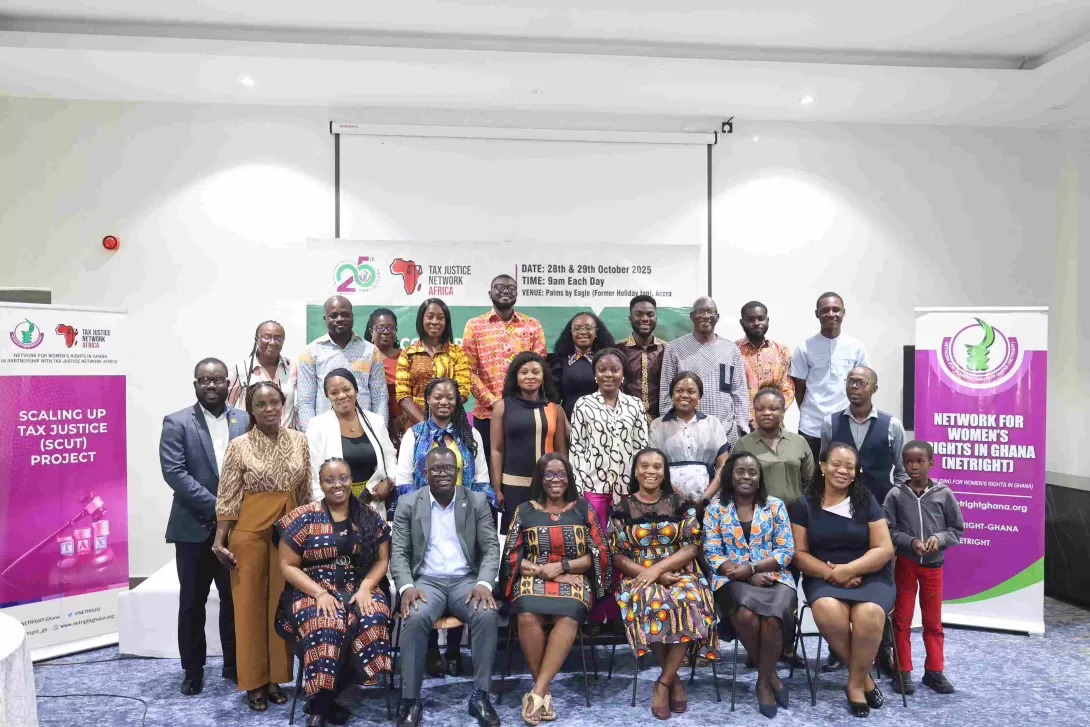
Tax Justice Network Africa, in collaboration with the Network for Women’s Rights in Ghana (NETRIGHT), convened a two-day Policy Conference on illicit financial flows (IFFs) in Accra, Ghana, from 28 to 29 October 2025.
Organised under the theme “Promoting Tax Justice and Curbing Illicit Financial Flows for Inclusive and Gender-Equitable Development in Ghana”, the conference brought together Members of Parliament, representatives of the Financial Intelligence Centre, academia, media, and civil society organisations.
The conference was organised under Phase 3 of the Scaling Up Tax Justice (SCUT III) project, which seeks to promote gender-equitable, fair, and progressive tax regimes grounded in a human-centred, rights-based, and pro-poor approach across nine African countries, including Ghana.
The discussions at the conference highlighted the pressing need to address the adverse impacts of illicit financial flows on national development. IFFs continue to deprive countries of much-needed resources, constraining investments in essential public services such as health and education while exacerbating capital flight. A significant share of these outflows stems from aggressive tax planning strategies employed by multinational corporations, including tax avoidance, evasion, the use of tax havens, and base erosion and profit shifting, all of which weaken governments’ ability to mobilise domestic resources.
Speakers noted that the reliance of many African governments, including Ghana, on regressive tax measures, often influenced by external conditionalities from international financial institutions, has further deepened gender inequality. Women, particularly those in low-income and informal sectors, continue to bear a disproportionate tax burden, as they allocate a higher portion of their limited income toward essential goods and services.
In Ghana, these structural challenges are particularly acute. Following its most severe economic downturn in more than three decades in 2022, the country entered an IMF Extended Credit Facility program (2023–2026). Although macroeconomic indicators have recently shown signs of stability, including declining inflation and a relatively stable currency, fiscal vulnerabilities remain. With limited access to international capital markets, domestic resource mobilisation (DRM) has become a critical pillar of Ghana’s economic recovery strategy.
A study by NETRIGHT presented during the conference provided an insightful analysis of Ghana’s tax system and its implications for gender and equity. Between 2014 and 2024, tax revenue accounted for nearly 79 per cent of government income, averaging 17.6 per cent of GDP. However, the country’s tax-to-GDP ratio remains below the African average of 18.6 per cent, reflecting inefficiencies in collection, weak enforcement, and underutilisation of property and wealth taxation. The study also revealed implicit gender biases in both direct and indirect taxes; not due to explicit discrimination, but as a result of socio-economic structures that leave women disproportionately burdened relative to their income.
Key highlights of the conference included a presentation by Professor Godfred Bokpin of the University of Ghana Business School on the theme “Illicit Financial Flows, Public Debt, Public Financing, and Public Services, and Gender Equality in Ghana.” He highlighted the urgency of scaling up domestic resource mobilisation and tackling IFFs, affirming that “Africa should exist for Africa and not for the rest of the world.”
Dr. Gloria Afful-Mensah, also from the University of Ghana’s Department of Economics, presented an analysis of Ghana’s 2025 National Budget, examining fiscal priorities and gender implications. While acknowledging progressive elements such as the removal of taxes on sanitary products, Dr. Afful-Mensah noted the challenges of implementation and criticised the abolition of betting taxes; , a move that benefits multinational corporations while leaving vulnerable youth further exposed to exploitation.
Hon. Rita Sowah, a Member of Parliament in Ghana, highlighted the importance of integrating the informal sector into budget formulation and the role of local assemblies in addressing fiscal leakages. She emphasised the value of collaboration with CSOs, whose research and data can strengthen policy design and accountability mechanisms.
At the conclusion of the conference, participants issued a strong call to action directed at the Government of Ghana, Parliament, the Judiciary, the Ministry of Finance, the Ghana Revenue Authority (GRA), the Financial Intelligence Centre, and other relevant institutions. They urged coordinated and urgent measures to improve domestic revenue mobilisation, address structural gender inequalities, curb IFFs and corporate tax avoidance, and enhance fiscal transparency and civic participation.
TJNA and NETRIGHT reaffirm their commitment to advancing gender-transformative tax justice through sustained advocacy, evidence-based research, and multi-stakeholder collaboration.
For more information about the Policy Conference on Illicit Financial Flows (IFFs), please contact Grace Arina at garina[@]taxjusticeafrica.net.
