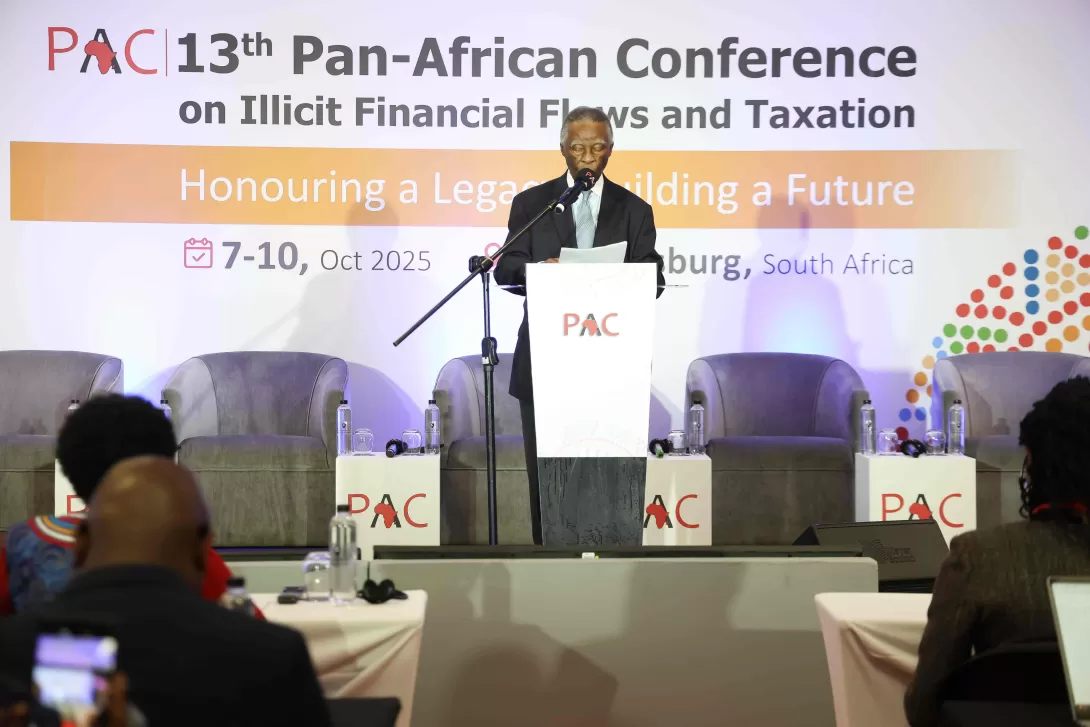
It is both an honour and a pleasure to join you at this 13th Pan-African Conference as we mark ten years since the publication of the High-Level Panel Report on Illicit Financial Flows from Africa and together examine ways and means to ensure that Africa has the necessary wherewithal to achieve its sustainable development.
When the High-Level Panel (HLP) submitted its Report in 2015, and as had been the desire of the ECA/AU Ministers of Finance, Economic Planning and Development when they decided on the establishment of our Panel, it made visible what had for too long been hidden, which was the massive haemorrhaging of Africa’s resources through illicit financial flows. The Report showed that the IFFs were not an abstract problem, but a very real drain on Africa’s capacity to finance its own development, provide social services, and build the industries and infrastructure necessary for the prosperity of Africa’s peoples.
The mere fact of detailing in one document all the principal elements relating to the illicit financial flows, together with the engagement the Panel had with various African countries as it prepared its Report, accomplished the strategic task of putting at the very centre of the consciousness of the broad African leadership the urgent task to combat the illicit financial flows. Thus, the mere knowledge of the reality of the problem created the possibility to lay the basis for action to address the problem.
Our Panel was therefore very happy that Africa’s most senior political leadership, meeting in an African Union Assembly of Heads of State and Government in January 2015, adopted the Panel’s Report, including its Recommendations. It was and remains of great importance that this AU Assembly adopted the ‘Special Declaration on Illicit Financial Flows’. What the Declaration said remains relevant to this day, as for instance, it drew attention to: “the growing need for domestic resource mobilisation for the attainment of our continental development visions and goals particularly Agenda 2063 and the Common African Position on the post 2015 Development agenda, which both call for inclusive growth, sustainable development and social and economic structural transformation of Africa through optimal utilization of our natural resource endowments…” Fully understanding the need to act on this matter, the Declaration requested: “the (AU) Commission, Economic Commission for Africa, African Development Bank, African Capacity Building Foundation and other development partners to build capacities of African Union member States and institutions, particularly in contract negotiation, tax management, regulatory and legal frameworks, policies, money laundering, asset recovery and repatriation, and resource governance for effective and optimal Management and Governance of our Natural resources.”
Correctly, because of the inherently international nature of these illicit financial flows, the Declaration: “expressed the need to ensure that Illicit Financial Flows and their impact on domestic resources mobilization is given the necessary attention by the 3rd International Conference on Financing for Development, and in this regard, stressed the need for robust international cooperation to address the problem.”
Of course, I must also mention that the Declaration authorised our Panel to work for the implementation of the Panel’s Recommendations, which were now AU policy, bringing on board, in addition to the Governments of the AU Member States, “a broad coalition of partners including civil society and the private sector.” I hope that the Conference will find time to assess how far these important directives have been implemented in order to answer the question – what improvements need to be effected?
In this context, I must mention that a notable element of the post-Declaration involvement of the Panel was that it had the task to report annually to the AU Assembly on the performance of each of the AU Member States in terms of the implementation of the AU decisions of the IFFs. The good news in this regard is that the Panel did not experience any resistance from any of the African countries when they were approached for such assessments.
The sad news is that in practice, the Panel has not submitted even one report to the Assembly. Accordingly, there are no reports available about how effectively the AU Member States have worked to implement the AU policies of the IFFs, as well as on the related matters of the capacities of the African States in this regard. The reason for this very sad piece of news is that, regrettably, the Panel ran out of funds to carry out the engagements with the individual African States, despite the keenness of the Panel to carry out its work in this regard.
However, I would like to assure the Conference that there are efforts currently being pursued, which will hopefully end this resource limitation, which made it impossible for the Panel to actually engage the individual African countries as had been agreed. We must also report that, as was absolutely necessary, our Panel engaged the international community to help ensure a coordinated global response to the IFFs. In this connection, I must mention our engagements with the World Bank, the IMF, the OECD, the US Government, and the UN ECOSOC. It was important that the 2015 3rd International Conference on Financing for Development put the matter of combating the IFFs on its Action Plan. This led to the adoption of this position by the UN General Assembly when it adopted the Sustainable Development Goals during the same year.
The 2025 4th International Conference on Financing for Development has maintained this position on combating the IFFs and confirmed engagement in the negotiations on a United Nations Framework Convention on International Tax Cooperation. It is true that as we engaged in our global outreach, there was a pushback to the work on highlighting the effect of illicit financial flows from Africa, in the form of a coordinated pushback from some sectors on whether aggressive tax planning and avoidance amounted to IFFs.
Happily, this effort has not stopped the adoption of a correct international posture against the IFFs. Over the past decade, we have seen the agenda we set begin to bear fruit. For instance, we have seen concrete reforms as beneficial ownership registers, automatic exchange of information, stronger transfer pricing capacity, and measurement capacities, all of which are tools that help our tax authorities to fight abuse. Yet, despite these advances, the scale of illicit outflows remains staggering. We must acknowledge that while we have succeeded in raising awareness and beginning reforms, we have not yet succeeded in stopping the outflows.
However, from a technical perspective, some African countries have strengthened their capacity to engage in complex areas of tax policy. Some of our partner organisations, such as ATAF and TJNA, have played important constructive roles in this regard. But here lies a challenge: despite Africa’s increased technical competence, the outcomes of global tax reform processes have not delivered the fairness we seek. The rules are not written in a vacuum; they are shaped by political power. Political Progress and Struggles.
Needless to say, I’d like to emphasise that political leadership is critical to achieve the required change. On the political front, Africa has taken important steps which, among others, culminated in the historic decision of the UN General Assembly in 2022 to begin negotiations towards a UN Framework Convention on International Tax Cooperation. This is no small achievement. For decades, the OECD has dominated global tax rule-making, with limited space for developing countries. It was through political unity, driven by the Africa Group, that the world finally recognised the need for a universal and inclusive forum. This achievement reflects a central lesson of the past decade: technical expertise must be matched with political mobilisation.
Only by uniting as a continent, and by speaking with one voice, can we hope to transform the global rules that so profoundly affect Africa’s capacity to mobilise its resources. These negotiations have reached a critical stage that demands active participation from African countries to shape the framework convention and its protocols so that our needs and priorities are fully reflected. At the same time, we must sustain rigorous technical work to generate the evidence-based arguments that will strengthen Africa’s position throughout the negotiation process.
As we look to the next decade, three considerations stand out;
• First, deepening domestic capacity: Even as we fight for fairer international rules, we must strengthen our tax administrations at home.
• Second, linking tax to Africa’s structural transformation: It is not enough to collect more revenue. We must design tax policies that actively support Africa’s industrialisation and job creation, in the context of the continuing struggle to break out of the neo-colonial economic paradigm.
• Third, securing Africa’s voice in global governance: The negotiations toward a UN Tax Convention will be a defining struggle of the next decade. Together with the Global South, Africa must continue to lead, not only to ensure inclusive participation, but to anchor the Tax Convention in principles of fairness, equity, and development.
Ten years ago, the High-Level Panel declared that Africa could not afford to lose one more dollar through illicit outflows. Ten years on, we must declare that Africa cannot afford another decade of subordination in the global financial system. If we succeed to defeat this subordination, as we must, then ten years from now we will no longer be speaking of resources lost, but of resources retained, mobilised, and deployed to build the Africa we want.
The next decade must be one of collaboration—of coming together in spaces like this to share, learn, and sharpen our collective strategies to curb IFFs. My heartfelt thanks go to TJNA and our co-convenors for organising the PAC, which embodies exactly this necessary spirit of solidarity and joint action. Together, we are laying the foundation for a future where Africa’s wealth works for its people. I thank you for your attention and officially open the 13th Pan-African Conference on IFFs and Taxation. Thank you.
